How marketing managers can plan smarter, create faster, and win on creative-first platforms (Meta + TikTok)
If you manage paid media (or manage the people who do), your 2026 calendar is not just a list of dates. It is your blueprint for when to spend, when to test, when to scale, and when to pull back so you don’t waste budget chasing results at the wrong time.
In 2026, the calendar matters more than ever because Meta and TikTok are now creative-first advertising platforms. That single shift changes how campaigns need to be planned.
This guide is designed to help marketing managers build a usable paid ads calendar for 2026, focused on the moments that actually matter, the lead times required to execute properly, and the creative volume needed to perform consistently.
Why your paid ads calendar matters more in 2026
The biggest lesson from 2025 is simple: performance is increasingly driven by creative and timing, not micro-targeting.
Meta and TikTok are now better at finding the right people than most advertisers are. Your competitive advantage is no longer hidden in complex targeting structures.
Your advantage is:
- showing up with the right message at the right time
- having enough creative variation to let the platform find winners
- deploying campaigns with clear conversion objectives and technically sound structures
Do this well and your calendar becomes a growth tool, not a stress tool.
Meta and TikTok are creative-first platforms (and your calendar must reflect that)
These platforms are no longer targeting-first. They are creative-first.
Every ad now has to do three jobs at once:
- stop the scroll (attention)
- qualify the user (message)
- convert (proof, offer, CTA)
The best targeting in the world cannot save weak creative. Strong creative, however, can outperform even with broad targeting because the platforms are designed to find responders.
This is why your calendar cannot just be dates and budgets. It must also be a creative production plan.
The biggest calendar mistake: planning for one creative per event
The most common mistake brands make is treating creative as a single hero asset.
In 2026, performance depends on volume and variation. Brands that focus too much energy chasing the “perfect” creative will consistently lose to brands presenting more diverse creative variations to the platform.
The new standard
For any key event or seasonal moment, plan to launch with:
- 3–6 primary creative variations
- 2–4 distinct angles
- coverage across multiple placements (feed, stories, reels)
The 2026 Paid Ads Calendar Framework
A strong paid ads year has two layers.
1) Always-on (year-round)
Always-on keeps lead flow steady, maintains algorithm learning, and reduces reliance on peaks. At Sod, this is standard practice across clients.
Typically includes:
- broad prospecting
- a consistent value proposition
- evergreen creative testing
- a simple remarketing layer
2) Peaks (planned bursts)
Peaks are moments when people are naturally more likely to buy or enquire.
Your calendar should define:
- which peaks you will activate
- the objective of each peak
- duration and warm-up periods
- required creative deliverables
The 2025 lessons that should shape 2026 planning
- Creative volume beats perfect creative
- Targeting is no longer a reliable competitive advantage
- Clarity wins: simple hooks, proof, and clear CTAs
- Short, cold bursts underperform on Meta and TikTok
- Launching late is the most expensive mistake
If your first week is your peak week, you are learning with budget instead of scaling with it.
Key dates that matter for paid ads planning
You do not need to plan around everything. Focus on moments that reliably shift demand and competition.
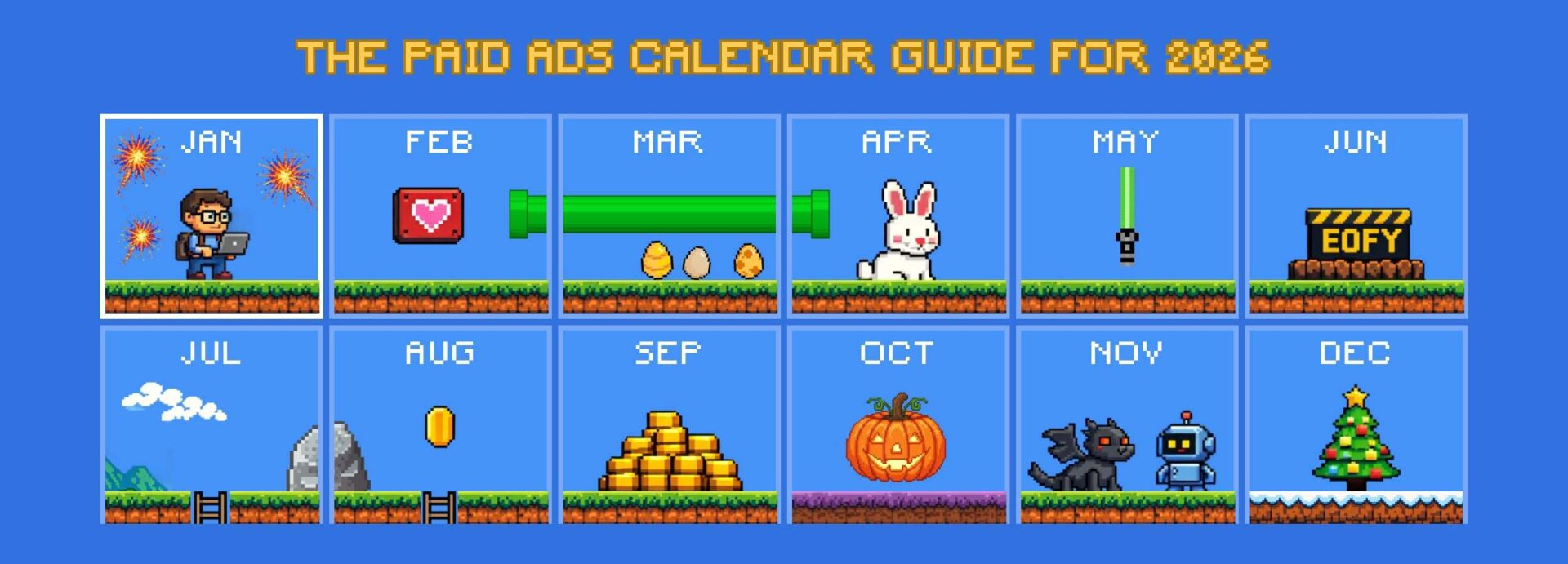
Core conversion seasons
- Valentine’s Day (February, category dependent)
- Easter and School Holidays (March/April)
- Mother’s Day (May)
- EOFY (June)
- Father’s Day (September)
- Black Friday / Cyber Monday (November)
- Christmas and Boxing Day (December)
- Summer Surge (December-February)
Context dates to mark
- public holidays and long weekends
- school holidays
Campaign lead times: when to start
Every peak should be planned in three phases.
The three phases
- Warm-up (testing and learning)
- Peak (scaling proven creative)
- Retargeting (conversion and urgency)
Default lead times
- Standard peaks: 4–6 weeks ahead
- Major peaks (EOFY, Black Friday, Christmas): 8–10 weeks ahead
If you want multiple creatives ready, you cannot build them in a week.
What a creative-first calendar entry looks like
Instead of:
EOFY Sale: June 1–30
Your calendar should outline:
- Warm-up testing: May 1–14
- Scale: May 15–June 30
- Retargeting: June 15–June 30
Creative deliverables
- 6 short-form videos (15–30s)
- 4 statics
- 2 carousels
- 10 hooks
- 3 proof assets
Landing page: EOFY offer + FAQ
Weekly check-in: Mondays
Review: early July
AI is changing paid social (but not replacing marketers)
AI is now embedded in platforms and production workflows. Its real impact is speed, not strategy.
Where AI helps
faster copy and hook variations
cut-downs for different placements
captions and subtitles
repurposing long content
adapting assets to platform styles
What AI will not replace
AI cannot create truly original, scroll-stopping concepts on its own. That still requires human insight into brand, audience, and culture.
The winning model for 2026:
- humans define the concept and angle
- AI accelerates production and variation
AI is a multiplier, not a replacement.
A caution on platform AI
Platform AI does not understand brand boundaries. Left unchecked, it can dilute tone and positioning.
Use AI for efficiency, but maintain strong brand governance. Helpful copilots are great. Autopilot without oversight is how brands drift off course.
While AI is transforming campaign creation, privacy changes are simultaneously reshaping how campaigns are measured. Understanding the cookie apocalypse is just as important as understanding creative automation.
TL;DR:
In 2026, paid ads performance is driven by timing and creative, not clever targeting. Plan your year around always-on campaigns, clear peak moments, and realistic lead times. Launch early, test with volume, scale what works, and use AI to move faster, not think for you. A strong calendar is now a performance advantage, not admin.
-
![]()
Multi-location marketing for franchise brands: how to scale local visibility
Sep 2026 4 min read -
![How AI search is changing the property buyer journey banner]()
How AI Search Is Changing the Property Buyer Journey
Sep 2026 4 min read