Google Says AI Optimisation Is Still SEO. We Think That’s Only Half the Story.

Google released its first official guide on optimising for AI-powered search this month – covering AI Overviews and AI Mode. The headline message is clear: SEO is still the foundation.
And on most of it, we agree.
Technical SEO still matters. Quality content still matters. Authority and trust still matter. For example, if your site has weak structure, thin content and no real authority, AI visibility isn’t going to magically save it.
Google also pushed back on a lot of the “AI optimisation hacks” currently flooding LinkedIn and Reddit threads:
- llms.txt files
- overcomplicated chunking strategies
- rewriting content specifically for AI
- chasing artificial AI mentions
- “secret” GEO tactics
Their position, more or less: stop looking for shortcuts. And on Google’s own products, they’re probably right.
Where We Think the Industry Is Oversimplifying
The fast-forming narrative is becoming “AI optimisation is just SEO” – and we don’t think it’s quite that simple.
Google’s guidance is written from Google’s perspective. It’s focused on Google products: AI Overviews, AI Mode and Gemini. But search behaviour is no longer centred on Google alone.
Users are increasingly discovering information through ChatGPT, Perplexity, Reddit, TikTok and YouTube – platforms that retrieve and surface information very differently. That matters, because AI retrieval is not the same thing as traditional search ranking.
Rankings Matter. Retrieval Changes the Game.
Traditional SEO has largely been built around rankings, backlinks, keywords and clicks.
AI systems behave differently. They retrieve passages. They compare multiple sources. They synthesise answers. They interpret relationships between brands, topics and entities.
Visibility becomes less about ranking #1 and more about whether AI systems can confidently:
- understand your content
- trust your expertise
- retrieve relevant information
- reference your brand in generated answers
This is also why structured data has become a bigger lever than ever – it gives AI systems a clean way to read and classify what you publish.
Insight: SEO gets you ranked. GEO/ AEO helps make sure you get retrieved, referenced and trusted by the systems generating the answers.
The Best Part of Google’s Guidance:
E-E-A-T
One of the more interesting points in Google’s release is its emphasis on “non-commodity” content – content based on actual experience, expertise and original insight. Not generic articles rewritten 500 times with slightly different headings.
AI can already generate endless amounts of surface-level informational content.
What it struggles to replicate is:
- lived experience
- strong perspectives
- genuine expertise
- unique insights
This isn’t a new direction. It’s exactly what E-E-A-T (Experience, Expertise, Authoritativeness and Trustworthiness) has been pointing at for years, and it’s one of Sod’s core SEO principles. We build every content strategy around it, and as the March 2026 core update showed, it’s only becoming more important.
The brand is adding something genuinely useful to the conversation are the ones most likely to stand out – in traditional search and in AI-driven search experiences.
Visibility Is Now Bigger Than Your Website
The other major shift we’re seeing is that AI systems appear to build understanding from a far broader set of signals than traditional search ever did.
Your visibility isn’t shaped by your website alone anymore. It’s also influenced by:
- third-party mentions
- Digital PR
- reviews
- social content
- broader topical associations across the web
AI systems are increasingly evaluating your broader digital presence and contextual authority, not just individual webpages. This is one of the reasons we think reducing everything to “it’s all just SEO” misses part of what’s actually changing.
What This Means for You
If you take one thing from Google’s guide and the wider AI search shift, focus on the fundamentals – but don’t pretend the playing field hasn’t moved. A few practical priorities:
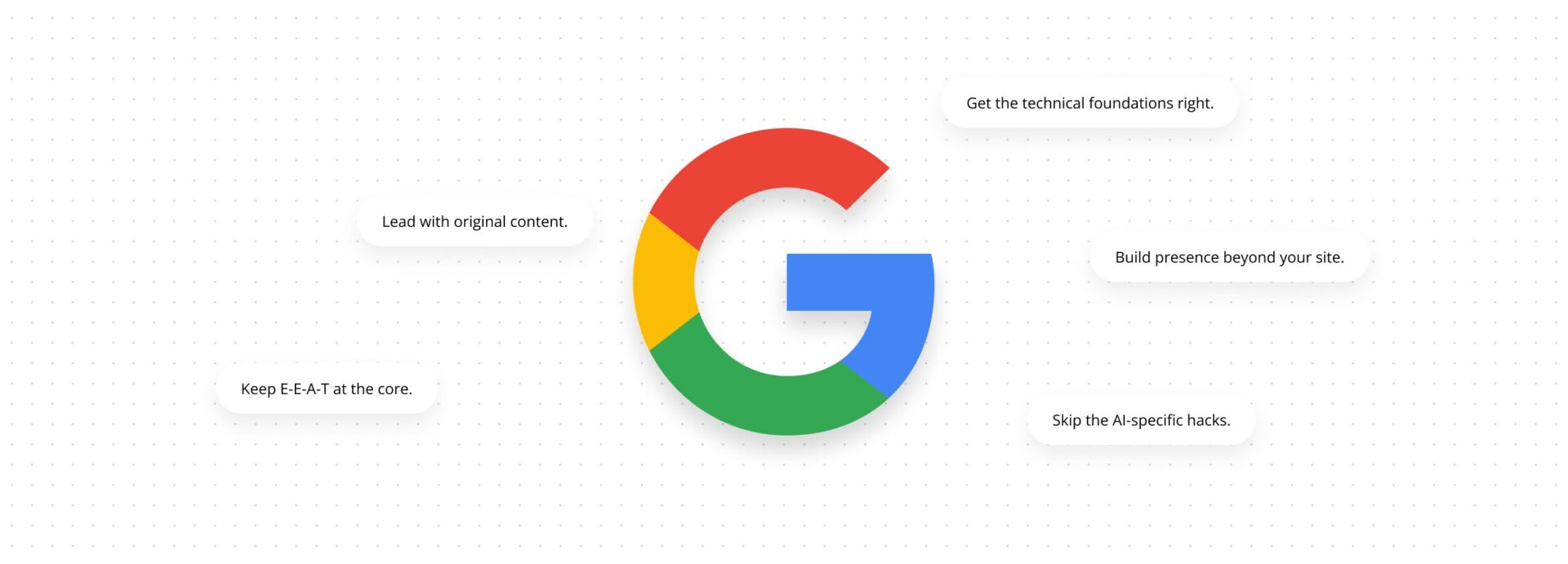
- Lead with original content. Anything a hundred other sites already say isn’t going to win. Lean on lived experience, real client outcomes and unique angles.
- Keep E-E-A-T at the core. Make experience, expertise, authoritativeness and trust visible across your site – authors, credentials, sources and real case studies.
- Get the technical foundations right. Crawlability, indexability and structured data, so AI systems can actually parse what you publish.
- Build presence beyond your site. Digital PR, reviews, third-party mentions and community visibility all feed how AI systems understand your brand.
- Skip the AI-specific hacks. No llms.txt, no over-chunking, no rewriting content “for AI.”
Our Take
On one side of this conversation, a flood of “AI SEO” hacks and overcomplicated optimisation tactics. On the other, the idea that nothing has changed at all.
The reality sits somewhere in the middle. The foundations still matter. Strong SEO is still critical. But AI-driven retrieval is introducing new visibility patterns that traditional SEO alone doesn’t fully cover.
The brands which we will see being the most successful over the next few years likely won’t just be the ones ranking #1. They’ll be the brands AI systems consistently understand, trust and reference.
-
![A collection of hospitality venue logos.]()
Hospitality Marketing: A Holistic Approach to Venue Growth
Aug 2026 5 min read -
![]()
Cut Meta for two weeks, lose 80% of your leads
Aug 2026 3 min read