Google Core Update March 2026: What Changed and What to Do Now

The Google March 2026 core update began rolling out on March 27, introducing a broad search engine update designed to improve how content is ranked globally. As with previous updates, this is not a penalty, but a re-evaluation of what Google considers helpful, relevant, and trustworthy content.
With noticeable SERP fluctuations already underway, businesses are asking the same question: what actually changed and how should we respond?
What is the March 2026 Core Update?
A Google core update is a broad adjustment to how Google’s algorithm ranks content across all industries, regions, and languages.
The March 2026 update – expected to roll out over approximately two weeks – impacts search results, Discover, and AI-driven experiences. Rather than targeting specific tactics, it reassesses content based on updated quality signals.
In simple terms: Google is refining how it identifies helpful, high-quality content at scale.
Who’s Impacted (Winners vs Losers)?
Winners
- Sites with strong topical authority
- Content that fully satisfies search intent
- Structured, easy-to-scan pages (clear headings, FAQs)
- Brands demonstrating expertise and trust
Losers
- Thin or generic content
- High-volume, low-quality blog strategies
- Pages created primarily for SEO rather than users
- Websites with inconsistent or unfocused topics
What Are We Seeing? (and What It Means)
While the rollout is ongoing, early SERP fluctuations suggest that Google is continuing to refine its evaluation of content holistically.
Historically, core updates don’t introduce entirely new ranking factors, they strengthen existing ones.
Sod Example: From E-E-A-T to AEO
A clear example of this shift can be seen in our SEO work with “Dr Len.”
Since taking over SEO in 2023, the focus has been on:
- High-quality, original content
- Strong E-E-A-T signals
- Avoiding shallow, AI-generated pages
More recently, the strategy has evolved toward AEO; structuring content to directly answer queries and rank within AI-driven search experiences.
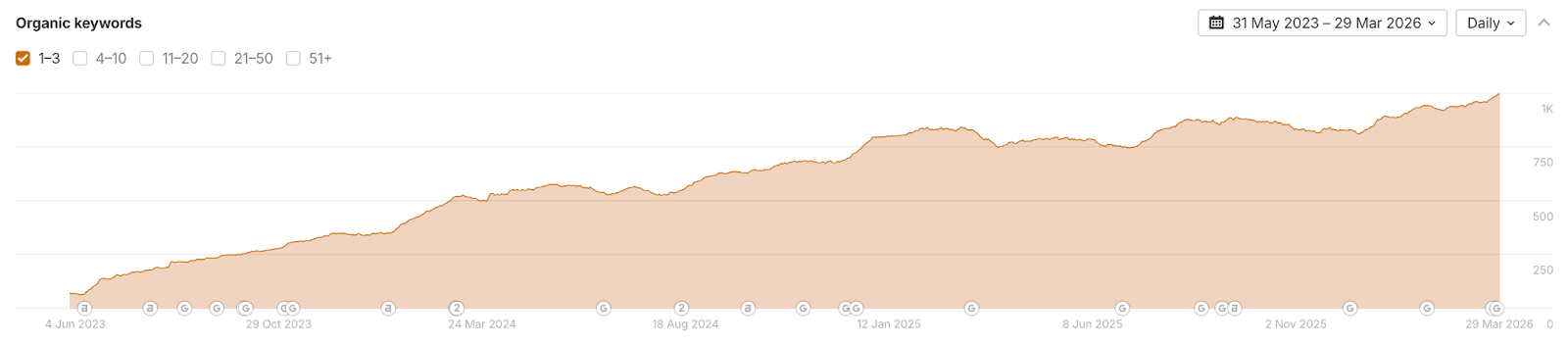
This resulted in consistent growth in keyword rankings in positions 1–3.
What Has Actually Changed?
While the rollout is still in progress, early signals and historical patterns highlight several key shifts.
Content Quality Threshold Has Increased
Google continues to prioritise genuinely helpful content over surface-level or templated pages.
Early volatility suggests that content lacking depth or originality is more likely to lose visibility.
At Sod, we’ve consistently seen that content created purely for rankings, without adding real value, struggles to maintain performance over time. In contrast, content built around insight, clarity, and user intent tends to perform more sustainably across updates.
Insight: This is a clear content quality update, raising the standard of what deserves to rank.
Search Intent Matching Is Smarter
Google is becoming more advanced in understanding why users search, not just what they search.
Content that:
- Directly answers questions
- Covers topics comprehensively
- Eliminates the need for further searching
…is increasingly prioritised.
Across Sod campaigns, pages aligned closely with search intent consistently outperform others, not just in rankings, but in engagement and conversion.
Insight: This reinforces the shift toward AEO (Answer Engine Optimisation), where complete answers outperform keyword targeting alone.
Topical Authority Matters More
Websites demonstrating consistent expertise within a focused niche are gaining stronger visibility.
Rather than ranking isolated pages, Google is increasingly evaluating site-wide authority.
We’ve seen that clients with structured content ecosystems, where multiple pieces support a core topic, experience more stable organic growth compared to those with scattered, unrelated blogs.
Insight: Authority is no longer page-specific, it’s built across your entire content strategy.
E-E-A-T Signals Are Strengthened
Google continues to emphasise Experience, Expertise, Authoritativeness, and Trustworthiness (E-E-A-T).
Content that reflects:
- Real-world experience
- Demonstrated expertise
- Credible, trustworthy information
…is more likely to perform well.
The good news is that E-E-A-T has always been a core principle for all of Sod’s content strategies.
Impact on AI-Generated Content
AI content itself is not penalised; but low-quality, generic output is.
This means:
- Mass-produced, shallow content is at risk
- High-quality, insight-driven content (AI-assisted or not) can still perform
Insight: The issue isn’t AI; it’s the lack of customer value.
What Should You Do Now?
Instead of reacting immediately to ranking changes, focus on long-term improvements.
1. Improve Content Depth
Ensure your content:
- Goes beyond basic explanations
- Includes insights, examples, and expertise
2. Align With Search Intent
Ask:
- Does this fully answer the user’s query?
- Would the user need to search again?
3. Build Topical Authority
- Focus on core subject areas
- Create supporting content clusters
- Avoid unrelated or low-value topics
4. Audit Low-Value Content
Identify and improve or remove:
- Thin pages
- Underperforming content
- Duplicate or overlapping topics
5. Structure for AEO
- Use clear headings
- Add FAQs
- Provide direct answers early
The March 2026 Google core update reinforces a clear direction for global SEO.
Content that genuinely helps users and answers their queries completely will outperform content created purely to rank.
For businesses, this isn’t just about adapting to one update; it’s about building a strategy that aligns with where search is heading next.
What is a Google core update?
A Google core update is a broad algorithm update that changes how content is ranked across search results globally.
How long does the March 2026 update last?
The rollout typically takes around two weeks, although ranking fluctuations may continue slightly beyond that.
Why did my rankings drop?
Ranking drops usually occur when other content is deemed more relevant or helpful—not because your site has been penalised.
Can you recover from a core update?
Yes. Recovery involves improving content quality, aligning with search intent, and building stronger topical authority over time.
-
![]()
Why brand authority matters more than ever | SEO/AEO
Aug 2026 4 min read -
![Lead generation depicted visually.]()
5 essentials that drive sales on an ecommerce website
Aug 2026 4 min read