What is brand authority and why does it matter in 2026?
Brand authority refers to how much trust, credibility, and recognition your brand holds in the eyes of search engines, AI platforms, and users. In 2026, brand authority is more important than ever as search evolves from keyword-based ranking to entity-based SEO and trust-driven evaluation.
Historically, SEO focused on optimising individual pages through keywords and backlinks. While these fundamentals still matter, Google’s latest updates now prioritise expertise and credibility in content, alongside broader brand reputation online. This shift is driven by AI-powered search, where platforms don’t just rank content they select authoritative sources.
This is where SEO brand authority becomes critical. It’s no longer enough to produce optimised content; brands must demonstrate:
- Consistent expertise in their niche
- Recognisable authority signals across the web
- High-quality content signals that reinforce trust
In short, modern SEO has an additional layer – you must become a trusted entity, not just a well-optimised website.
How does brand authority influence Google rankings and AI search results?
From a search engine’s perspective, brand authority is about delivering the most credible result as quickly as possible. Platforms like Google aren’t just competing with other search engines anymore, they’re competing with AI platforms and instant-answer tools. Their goal is to surface trusted, authoritative content fast, which is why recent updates prioritise EEAT, entity-based SEO, and strong trust signals.
To determine this, search engines evaluate authority through:
- On-page SEO: Content depth, topical relevance, and clarity
- Technical SEO: Site performance, structure, and accessibility
- Off-page SEO: Citations, mentions, and external validation
Together, these form a holistic and consistent SEO strategy that signals trust and credibility.
From an AI search optimisation (AEO) perspective, authority is even more critical. AI platforms are not only ranking content but selecting trusted sources to generate answers. They prioritise:
- Authoritative sources in SEO
- Strong user trust and engagement signals
- Recognised brands with consistent messaging
This means that even well-optimised content may not appear in AI Overviews unless the brand itself is seen as credible. Ultimately, search is shifting from ranking pages to curating trust… and authority is what determines visibility.
What signals tell Google and AI platforms that your brand is authoritative?
Search engines now assess authority based on how your brand performs as a whole, not just how well a single page is optimised. The more your brand shows it knows its space and delivers reliable information, the more likely it is to be prioritised in both search rankings and AI-driven results.
Key authority signals include:
- Strong author expertise and credibility
- Citations and brand mentions from reputable sources
- Consistent content depth and topical relevance
- Clear and unified brand messaging
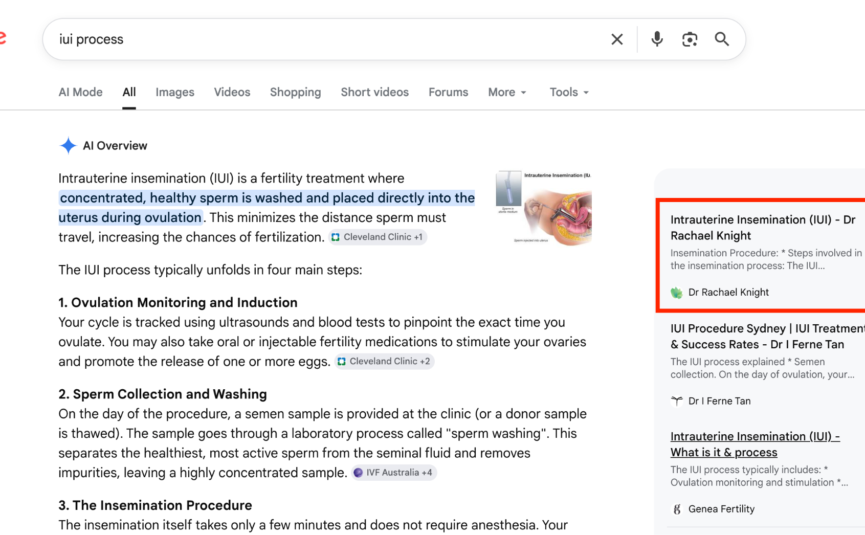
A strong example of this is our client, Dr Rachael Knight. As a fertility specialist, Dr Rachael Knight already had deep expertise, but we helped translate that into stronger digital authority by:
- Refining content structure to improve clarity and depth
- Aligning content with EEAT SEO principles
- Analysing high-volume enquiries and AI-driven search prompts to identify what users are actively looking for
This made content easier for both search engines and AI platforms to interpret and prioritise, increasing their visibility in high-value search results.
Image 1: Highlights Dr Rachael Knight featured as a source in Google’s AI Overview.
How can you build brand authority through SEO, content, and digital PR?
Building brand authority requires a long-term approach that blends SEO, content, and digital PR into a cohesive strategy.
It starts with creating high-quality, expert-led content that clearly demonstrates real knowledge and experience.
From there, brands need to develop topical authority by consistently producing in-depth content around key themes, rather than relying on one-off blogs. This strengthens relevance and signals to search engines that your brand is a go-to source within its niche.
Off-page, digital PR and brand mentions play a critical role. Authority today goes beyond backlinks; it’s about how often your brand is referenced and validated externally.
How do you measure brand authority and its impact on traffic, rankings, and conversions?
Measuring brand authority requires a combination of qualitative and quantitative metrics.
Key indicators include:
- Growth in organic traffic and keyword rankings
- Visibility in AI search results and featured snippets
- Increase in branded search queries
- Backlink quality and referring domains
- Engagement metrics (time on page, interaction rates)
From an SEO content strategy perspective, brands should also monitor:
- Topic coverage across their niche
- Performance of authority-driven content
- Conversion rates linked to trust-based messaging
Simply put, strong authority leads to higher rankings, better engagement, and increased conversions.
FAQs
What is brand authority in SEO?
Brand authority in SEO refers to the level of trust, credibility, and expertise a brand demonstrates, influencing how search engines rank and prioritise its content.
Why is brand authority important for AI search results?
AI platforms prioritise authoritative brands because they rely on trusted sources to generate accurate responses, making authority critical for visibility.
How can I improve my brand authority online?
You can improve brand authority by creating high-quality content, building backlinks, leveraging digital PR, and maintaining consistent brand messaging.
How long does it take to build brand authority?
Building brand authority is a long-term process that typically takes months to years, depending on consistency, content quality, and external validation.

-
![]()
Multi-location marketing for franchise brands: how to scale local visibility
Sep 2026 4 min read -
![How AI search is changing the property buyer journey banner]()
How AI Search Is Changing the Property Buyer Journey
Sep 2026 4 min read