
People are searching in more specific and conversational ways. Rather than simply searching “homes for sale in [suburb]”, they might ask “what’s the median unit price in [suburb] right now?” Creating content that answers these specific questions can help you capture more relevant searches and increase visibility across both search engines and AI platforms. Just make sure property prices and market information are kept accurate and up to date.
Your Google listing outranks your homepage
For agencies with multiple offices, each Google Business Profile is now a ranking unit in its own right, separate from the domain it sits under. We regularly see agencies with strong websites and weak profiles get outranked by competitors with the reverse. Before touching a single page of content, check:
- Category selection for each branch, and whether it’s been reviewed since setup
- Service area accuracy, especially where a branch covers more suburbs than it’s listed for
- Review response time and consistency across offices, which feeds directly into local pack visibility
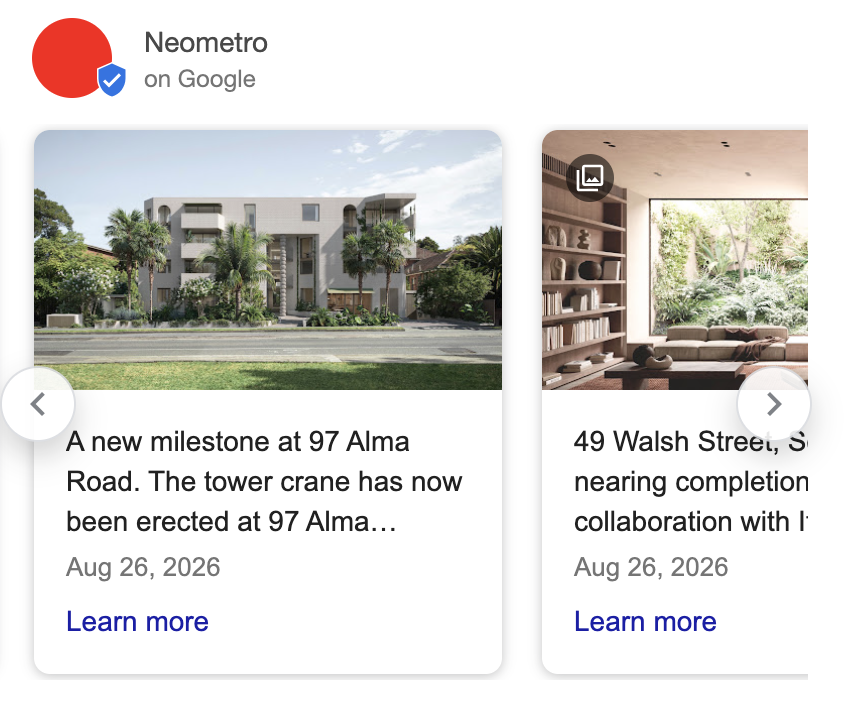
For example, we’ve helped Neometro make better use of their Google Business Profile by sharing project updates and milestones, keeping their listing active and giving potential customers more reasons to engage directly through Google.
Structured data is more than a technical checkbox
Schema markup has always helped Google parse a page correctly, but its role has expanded. It’s also the layer that AI Overviews and similar tools rely on to extract clean, attributable facts about an agency, an agent, or a suburb. Get it right and you improve both at once. The gaps we see most often:
- RealEstateAgent schema missing or incomplete on individual agent pages
- Listing schema (Product or RealEstateListing) inconsistently applied across the site
- Review schema not linked back to the agent or listing it relates to
Sites without this in place lose ranking strength in standard search results, and are effectively invisible in AI-generated ones. It’s a distinct problem from content quality and needs its own audit.
Build authority around individual agents
Google’s trust signals increasingly reward named individuals with a visible, consistent digital footprint over generic agency branding. An agent page with a real sold history, genuine specialisation in one or two suburbs, and reviews attributed to that person by name will often outrank a broader “our team” page built for the whole office.
If your agent profiles are thin, templated, or missing sold data, that’s a gap competitors with stronger individual profiles are already exploiting.
Why consistency across property portals matters
Name, address and phone details need to match exactly across every place your agency appears:
- Your website and Google Business Profile
- realestate.com.au and Domain listings
- Local directories and any industry association pages
Inconsistencies here (a missing suite number, an old phone line still listed somewhere) quietly erode local trust signals over time, and they’re easy to miss because no single platform flags the mismatch. A proper audit checks every listing, not just the obvious ones.
Authentic reviews matter more than quantity
More reviews help, but volume on its own isn’t the signal to chase. What matters is that reviews genuinely describe what it was like to work with your agency, and that they cover the range of services you offer:
- Selling a home
- Buying property
- Leasing
- Property management
Ask real clients for honest feedback rather than prompting for a five-star rating. A review that mentions the actual experience gives future clients useful context, and gives Google a clearer, more specific signal than a generic rating ever will.
Responding to reviews matters too, but keep it natural. A reply stuffed with suburb names and service keywords reads as manufactured, and it undermines the trust the review was meant to build.
Search queries are becoming more specific
Searchers are using more detailed, conversational queries, such as “what’s the median unit price in [suburb] right now” rather than broad terms like “homes for sale in [suburb]”.
Answering these specific questions can help capture long-tail searches and improve visibility in AI-powered search. Just make sure the information is accurate, useful and regularly updated, particularly for property prices and market data.
Where we recommend starting
If you’re not sure which of these is costing you the most visibility, start with a technical and profile audit rather than a content refresh. We’d recommend this sequence for most property agencies:
- Fix Google Business Profile inconsistencies across every branch
- Add proper structured data across agent and listing pages
- Move to content, once the first two are solid
The first two can be assessed and corrected within a few weeks. We’re happy to run through what that would look like for your current setup. Contact Sod to get started with an audit of your agency’s local search presence.

-
![A client reading in a clinic waiting room]()
How AI is changing healthcare UX and patient journeys
Nov 2026 4 min read -
![]()
Why we’re moving from WordPress to Payload
Nov 2026 6 min read