Short-term wins vs long-term growth: How to balance your digital marketing strategy

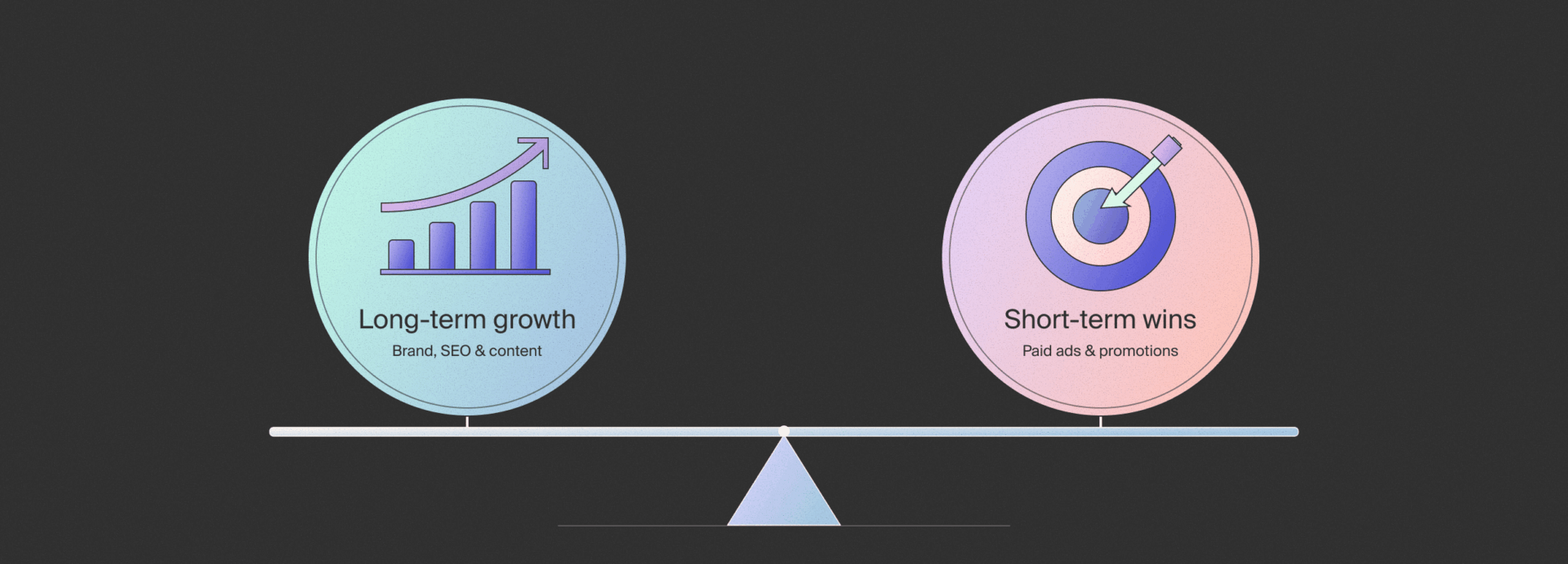
Every digital marketing strategy pulls in two directions at once. Paid ads want results this week. SEO and content want a 12-month runway, minimum.
Get that balance wrong and there are two ways to lose. Burn cash chasing quick wins that don’t compound, or get so focused on the long game that the business runs out of momentum before the payoff shows up.
At Sod, we build campaigns for clients who need both: the traffic and leads that keep this quarter’s numbers healthy, and the organic visibility that keeps customer acquisition costs down two years from now. Whatever shape your online marketing strategy takes, getting that balance right matters more than any single channel. Here’s how we think about it.
Why every digital marketing strategy needs both a sprint and a marathon plan
Short-term marketing (Google Ads, Meta Ads, promotions) is the sprint. It drives clicks, leads and sales fast, and you can measure it within weeks.
Long-term marketing (SEO, content, brand building) is the marathon. It compounds slowly, but it eventually lowers your cost of customer acquisition and gets you off the paid spend treadmill.
Treat your strategy as only one or the other and you’ll hit a ceiling. All sprint, and you’re paying for every lead forever. All marathon, and you might not have a business left by the time the organic traffic shows up. The strongest marketing plans run both, with clear objectives attached to each.
How can I focus on short-term marketing without losing sight of long-term growth?
Paid channels, Search, Shopping, PMax, social ads and other PPC advertising, are the fastest way to generate leads and sales while your organic foundations gradually build. Running the AFL Store’s merchandise campaign, we generated from 0 to over 40,000 sales through paid ads alone, with a conversion rate of up to 5% and a return on ad spend (ROAS) of up to 11 across Meta and Google campaigns during the peak of the AFL season.
The trick is making short-term wins feed the long game rather than work against it. Every paid campaign should also strengthen your conversion rate optimisation and feed data back into your SEO and content plans.
How do I know what my business needs most: short-term wins or long-term growth?
It depends on where the business is and what it can sustain. Cash flow pressure or a product launch? You need short-term marketing now, with long-term equity building alongside it. Got a runway and a long sales cycle? You can afford to weigh your strategy toward organic.
We start by understanding a client’s actual objectives, not just their marketing goals. That’s why for our clients who invest in both SEO and paid media, we treat it as one integrated digital marketing plan rather than separate budgets competing for attention internally.
Can SEO generate results in both the short and long term?
SEO is a marathon, not a sprint. Most clients see the full impact of organic search land somewhere between 12 and 24 months in, once technical foundations, content and authority-building have had time to compound.
The sequencing matters: we get technical SEO right first, since a site Google can’t crawl and understand won’t benefit from content no matter how good it is. From there, we build content that’s genuinely useful for customers and demonstrates real experience and expertise, not content for content’s sake.
Those technical fixes such as structured data (schema), core web vitals improvements and resolving crawling or indexing errors can have an immediate effect on how well a search engine understands and ranks a website. These early wins aren’t a separate track from the long-term gains, they’re the foundation the long-term gains build on. Once a site is easy for Google to crawl and understand, the content and authority work that follows compounds faster, and rankings, traffic and conversions keep building on top of it rather than restarting from scratch.
Common mistakes when balancing short-term and long-term marketing
The most common mistake is treating organic and paid marketing as competing budgets, fighting over the same pool of money, rather than one integrated strategy working toward the same goal. Once they’re split into separate camps, they start pulling against each other instead of pulling together.
A close second: judging SEO against a paid media timeline. Paid gives you an answer in weeks. SEO doesn’t work that way, and businesses pull the budget just as it was about to pay off, often right before the compounding kicks in.
The fix isn’t complicated, even if it takes discipline to stick to. Get short-term and long-term marketing sharing the same data, the same goals and the same reporting, so no one’s making a call on one channel without seeing what the other is doing.
How to build a digital marketing strategy that balances both
Start with the marketing funnel, not the channel list. Map where customers come from today (paid search, social, direct) and where you want organic traffic to eventually replace paid spend. Set marketing objectives for both horizons: this quarter’s cost per lead, and next year’s share of organic traffic.
For Zart Art, that meant combining SEO and social media ads so paid channels handled immediate lead generation while SEO built the organic pipeline turning enquiries into sales over time. That’s what an integrated digital marketing strategy looks like in practice, channels working toward the same outcome, which is where sustainable business growth actually comes from.
Find your strategy
For over 12 years, Sod has partnered with businesses across hospitality, retail, property, NFP, healthcare and B2B to deliver integrated digital marketing strategies that drive both immediate results and sustainable long-term growth. We combine SEO, paid media and performance marketing to help businesses invest in the channels that deliver the greatest impact.
Whether you’re looking to generate leads quickly, build long-term organic visibility, or create a balanced strategy that achieves both, our team can help you identify the right approach for your business.
Get in touch with Sod to talk through your digital marketing strategy.
FAQs
What are the risks of relying only on paid advertising?
Relying only on paid advertising means your traffic stops the moment you stop spending, so there’s no compounding value and no organic safety net if the budget gets cut. Cost per lead tends to rise over time as competitors bid up the same keywords, and you’re left with no brand presence or authority in search once the ads switch off.
Should a new business focus on short-term or long-term marketing first?
Most new businesses need short-term marketing first to generate cash flow and customer acquisition, then build long-term SEO and content alongside it. Waiting for organic growth alone usually isn’t sustainable without paid support in the early stages.
What’s the right split between short-term and long-term marketing spend?
There’s no fixed ratio, it depends on cash flow and how quickly the business needs results. A common starting point is 60/40 or 70/30 in favour of paid while SEO and content build, shifting toward organic as it starts to compound, often 12 to 24 months in. Businesses with more runway can afford to weight the split toward organic sooner.
Should I put my whole marketing budget into paid ads or SEO?
Neither on its own. Paid ads dry up the moment you stop spending, and SEO alone won’t cover a business that needs leads now. The stronger approach splits budget across both, using paid to cover the gap while SEO builds, then shifting weight toward organic as it starts to compound.
-
![]()
Multi-location marketing for franchise brands: how to scale local visibility
Sep 2026 4 min read -
![How AI search is changing the property buyer journey banner]()
How AI Search Is Changing the Property Buyer Journey
Sep 2026 4 min read